The platform powering Connected Funding

One platform. Two sides. The whole journey.

Everything on this page is live in the product today. Grantary gives funders and charities one shared place to run funding — from designing a programme and applying, through delivery and evidence, to reporting and the final audit pack. Here's what it does for funders, what it does for charities, and what becomes possible because both sides work from the same record.

Programme designApplicationAssessmentAwardDelivery & evidenceReportingImpact

For funders

Run fair, well-run programmes — with less administration.

Design a programme once and everything downstream inherits it: the application form, the assessment, the award and the live grant itself. Nothing is re-keyed between systems, every decision keeps its reasons, and oversight of delivery comes from the same record your charities keep — not from chasing them for updates.

Set up & invite

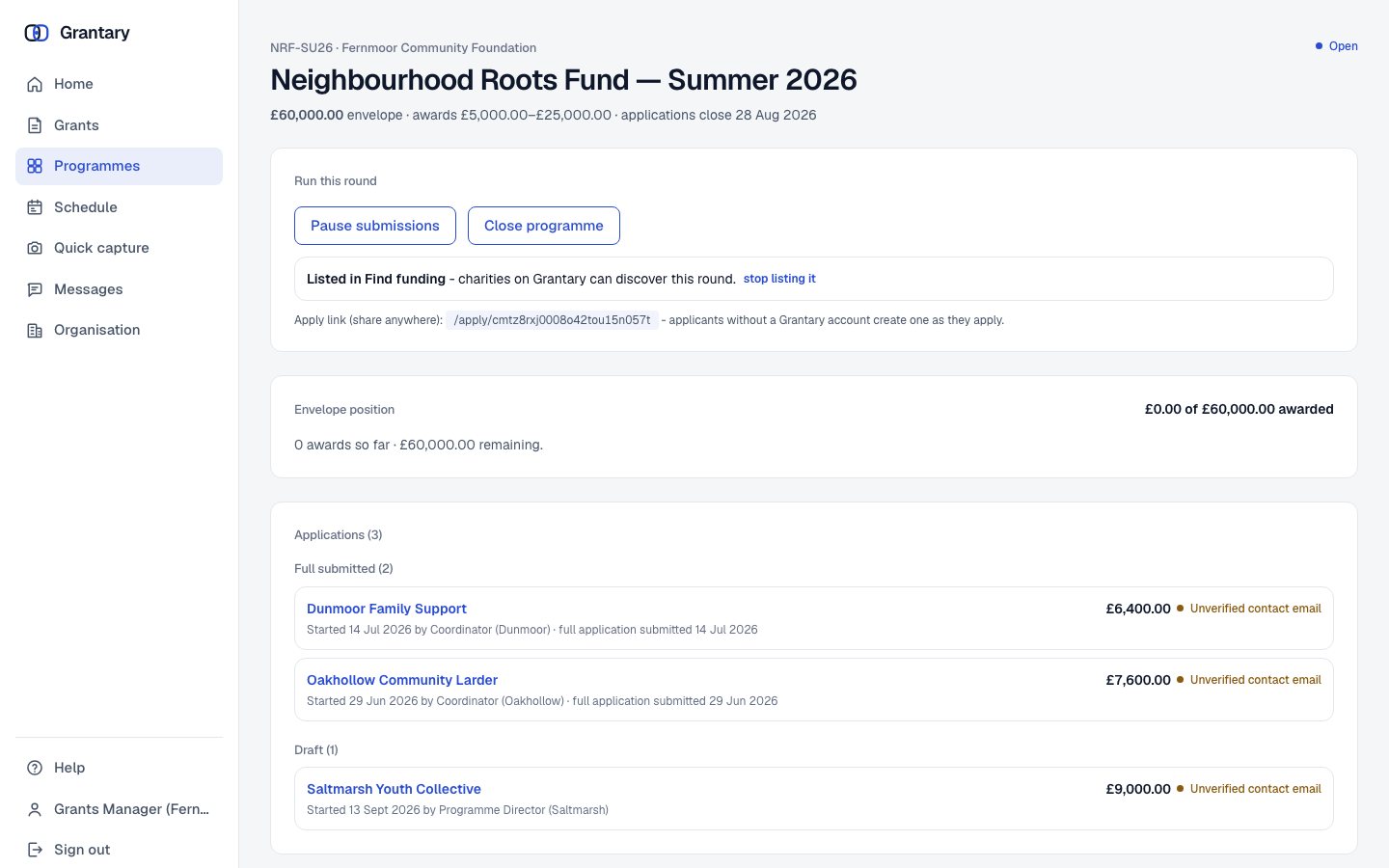
Programmes & applications

The funder dashboard's programme pipeline: outcomes donut and received-versus-awarded trend
Your round at a glance: received, in assessment, awarded, unsuccessful — and how it moved month by month.
  • Design your programme onceset the budget, award range, application windows, eligibility rules, questions and scoring criteria in one place. A built-in review warns you before you publish if the form asks small organisations for more work than the award justifies.
  • Applications arrive through one linkany charity can apply through a single web link — no PDFs to email, no accounts to set up in advance. A first-time applicant creates their organisation as they apply.
  • Eligibility checked before assessmentevery application is checked against your rules and against the official registers — the Charity Commission and Companies House — before anyone starts scoring. Clear answers your panel can stand behind, and anything uncertain is flagged for a human to review rather than quietly waved through.
  • Sift first, then inviterun a short expression-of-interest stage to narrow the field before anyone writes a full application. Invited applicants carry straight on — nothing is retyped.

Decide well

Assessment & award

  • People decide — never an algorithmsome platforms now use AI to score and shortlist applications. Grantary deliberately doesn't. A funding decision changes what happens in a real community, and an applicant who asks “why?” deserves an answer a person can actually give. So no application here is ever scored, ranked or rejected by AI — where AI helps at all, it helps people write; it never judges what they wrote.
  • Score fairly, side by sideassessors score against your published criteria, and every score keeps its written reasoning. Compare applications on the same basis, not on memory.
  • Conflicts of interest handled up frontan assessor confirms they have no conflict before they can open an application — and anyone connected to the applicant organisation is refused automatically.
  • Every decision carries its reasonsaward, decline or invite to the next stage — the rationale is recorded with the decision, ready for the day anyone asks why.
  • Every applicant can hear how to come back strongeron top of the formal reasons, send any applicant — including unsuccessful ones — written feedback: what came across strongly, what would make the next application stronger. AI can offer a first draft built only from what your panel actually recorded, but a person edits every word and the sending is theirs. Most applicants never get this from a funder; yours will.
  • An award becomes a live grant in one clickthe conditions, milestones, reporting dates and payment schedule are created from your programme design and the winning application. The charity accepts the award by confirming the record — and delivery starts from day one, already organised.

The agreement

Conditions that work in practice

The funding conditions register grouped by category, with live checks showing conditions being met or breached
Every string attached to the money: where it came from, who owns it, what it means — and whether it's being met right now.
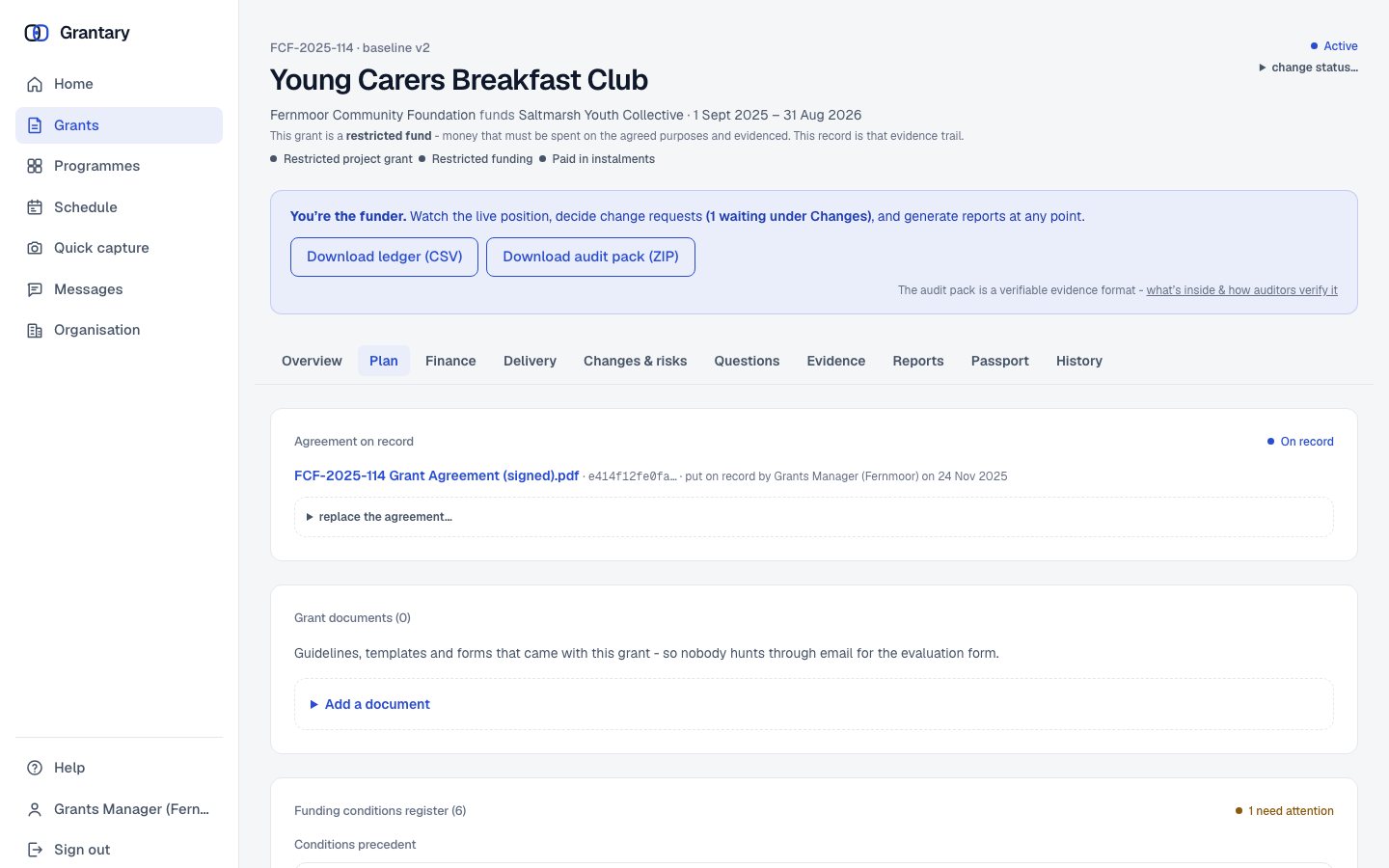
  • Templates for every common grant shapefrom a small project grant to multi-year, capital, research or outcome-based funding — each produces a plan that's proportionate to the size and risk of the award, not one-size-fits-all paperwork.
  • Every string attached, written down properlyeach condition on the money records where it came from, who is responsible, when it's due — and what happens if it isn't met. No surprises buried in clause 14.
  • Conditions that watch themselvesconditions tied to spending or delivery show whether they're being met right now, based on what's actually being recorded — not on what someone remembers at report time.
  • Conditions can sit on a paymentattach a condition to a specific instalment so both sides can see exactly what a payment is waiting on. It informs the decision — it never stops reality being recorded.

For charities & grant recipients

Win funding, deliver it, and prove it — without drowning in admin.

Grantary is free for charities, CIOs and CICs to join and to apply for funding. Your organisation's story is kept once and reused everywhere, the day-to-day of delivery becomes your evidence as you go, and the record you build is yours — protection for your organisation, not surveillance of it.

Winning the money

Find funding & apply

The charity home dashboard's applications panel: awarded, in assessment and unsuccessful counts with monthly outcomes, above the funds position by funder
Your applications and your funds position, side by side — what you've won, what's pending, and what each funder has paid.
  • Funding that fits, in one placebrowse open opportunities by award size, deadline, who can apply and where you work — including government grants from GOV.UK, clearly marked. A filter only ever hides funding that has genuinely ruled you out; if a funder hasn't stated a restriction, you'll still see the round.
  • Apply without the re-typingyour organisation's details, documents and track record are already on file — applications draw on what Grantary already knows about you instead of starting from a blank form.
  • A head start on your answerswhere a funder has enabled it, Grantary can offer a first draft of unanswered questions built only from facts you've already recorded. It never invents numbers, never overwrites your words, and nothing is submitted without you.
  • Every application in one viewwon, unsuccessful, in assessment and still in draft — your whole funding pipeline in one place, so trustees hear the full picture, not just the wins.

Tell your story once

The organisation passport

The shared organisation passport: documents with verification badges from self-declared through funder approved
Held once, shared on the charity's terms — and every entry shows how far it's been corroborated.
  • Your organisation's record, kept onceregistration, policies, insurance and accounts live in one locker — reused in every application and shared with every funder, instead of being emailed again for each one.
  • Verified against the official registersyour charity, company or CIC status is checked daily against the Charity Commission and Companies House — an independently confirmed status, not just a claim on a form.
  • Claims and proof, kept honestevery entry shows how far it's been corroborated — from self-declared, to document supplied, to approved by a funder. Nobody has to guess what's been checked.
  • Shared on your termsyou choose which funders see which categories, you can withdraw access at any time — and you always see exactly what they see.

The work & the proof

Delivery, outcomes & evidence

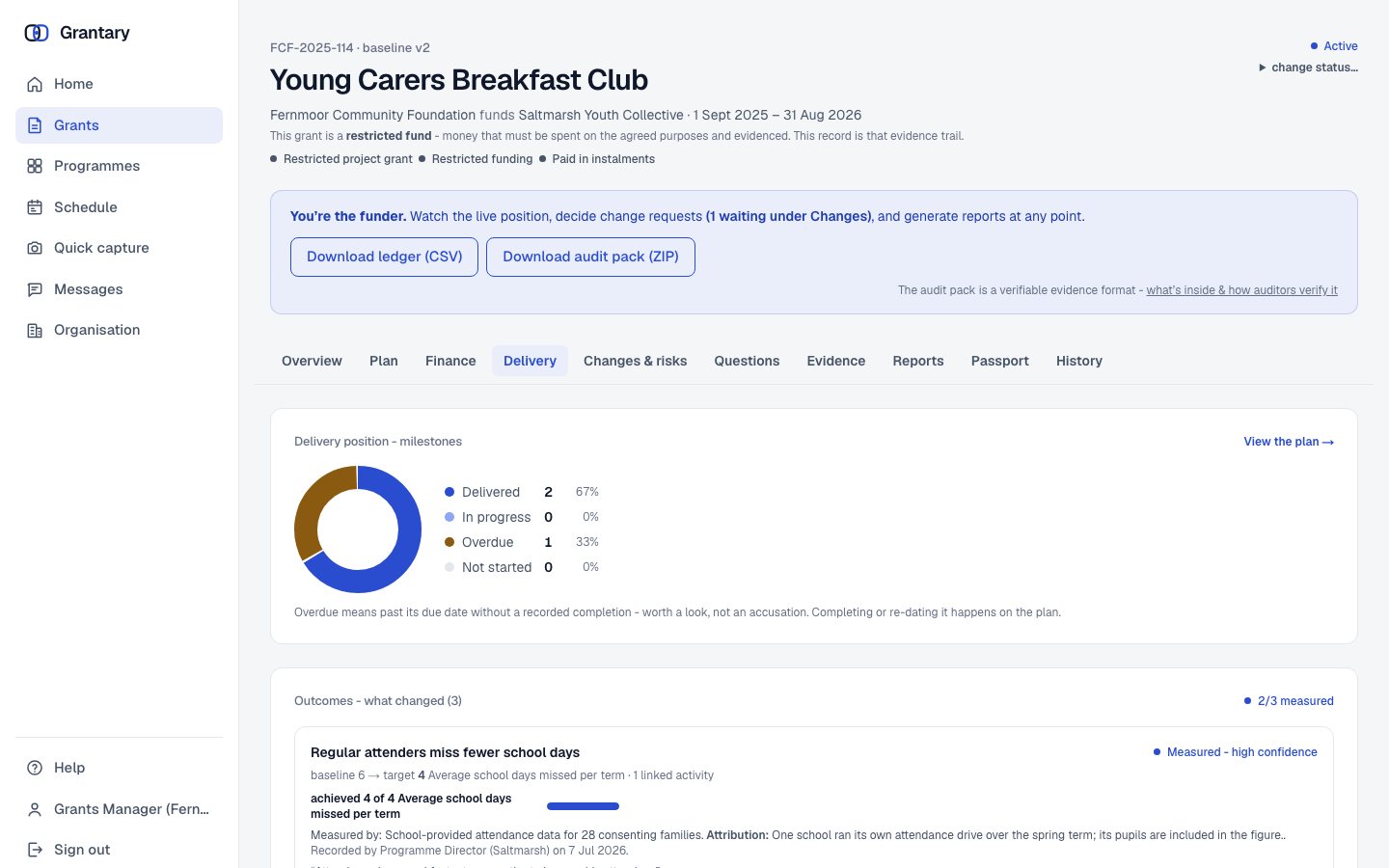
The delivery tab: milestone progress and measured outcomes with confidence ratings and attribution notes
Outputs delivered, outcomes measured — each with its method, a confidence rating and an honest note on attribution.
  • Record delivery as it happensa simple log of each session — date, venue, headcount, the paperwork — captured on the day, not reconstructed the weekend before a report is due. Anything logged late is honestly marked as logged late.
  • Upload once, use everywhereone attendance register can support a milestone, a condition, a report and an outcome at the same time. Link it — never upload the same file four times. For a small team, this is the single biggest admin-saver.
  • Evidence nobody can quietly changeevery file is sealed the moment it's uploaded. Replacing or withdrawing a document always happens in the open, with the reason kept on record — which is exactly what makes your evidence worth something later.
  • Impact told honestlywhat you did and what actually changed are recorded separately, and every result carries how it was measured and how confident you are. Funders trust it more because it never overclaims.

The money

Money, tracked honestly

The charity home dashboard: portfolio by status, money in versus spend recorded, outstanding actions and upcoming deadlines
Money in vs spend recorded across your whole portfolio — every number one click from the record behind it.
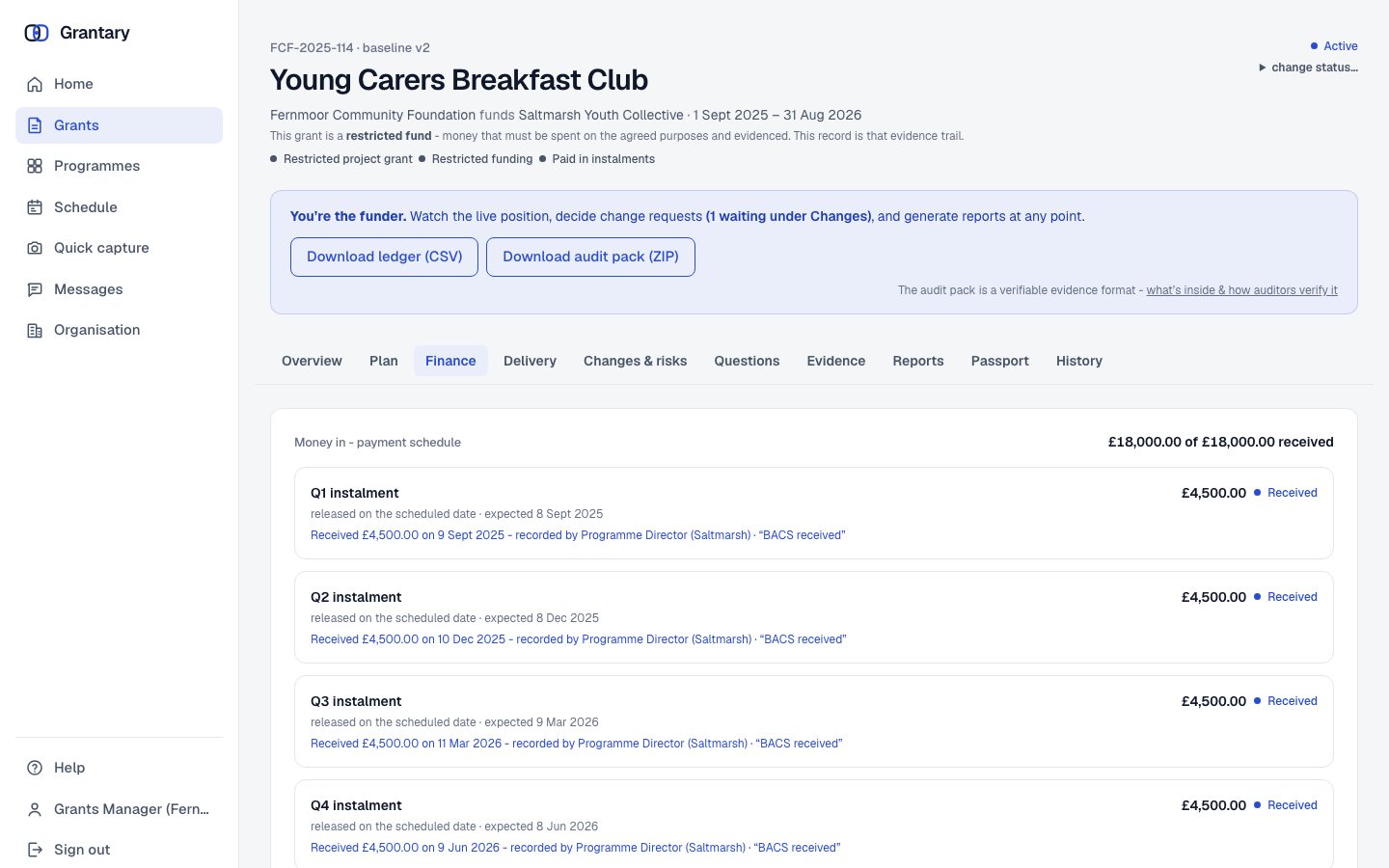
  • Know what's due, record what arrivesthe payment schedule shows every expected instalment and what triggers it. You record what actually arrives — and if it's short or late, that's visible immediately instead of surfacing at year-end.
  • Spending checked as you goeach expense is checked against the agreed budget the moment it's recorded — outside the funding window, over a budget line, a possible duplicate, a missing receipt. Problems surface while they're still easy to fix, and nothing ever blocks you from recording what happened.
  • Get ahead of the hard questionspacing and pattern signals — spend running behind the timetable, suspiciously round numbers, everything landing in the final month — are raised as friendly prompts to you first, so you can sort the story out before a funder asks.
  • Grantary never touches the moneyno payments run through the platform. It keeps the trustworthy record of money promised, money received and money spent — that's the point.

Joined up

One shared record both sides can trust.

This is the difference. A funder's system and a charity's spreadsheet always drift apart — Grantary is one live record that both sides see, so there is never a funder version and a charity version of events. When something needs discussing, deciding or proving, it happens in one place, on the record, in view of everyone it affects.

When plans change

Changes, risks & questions

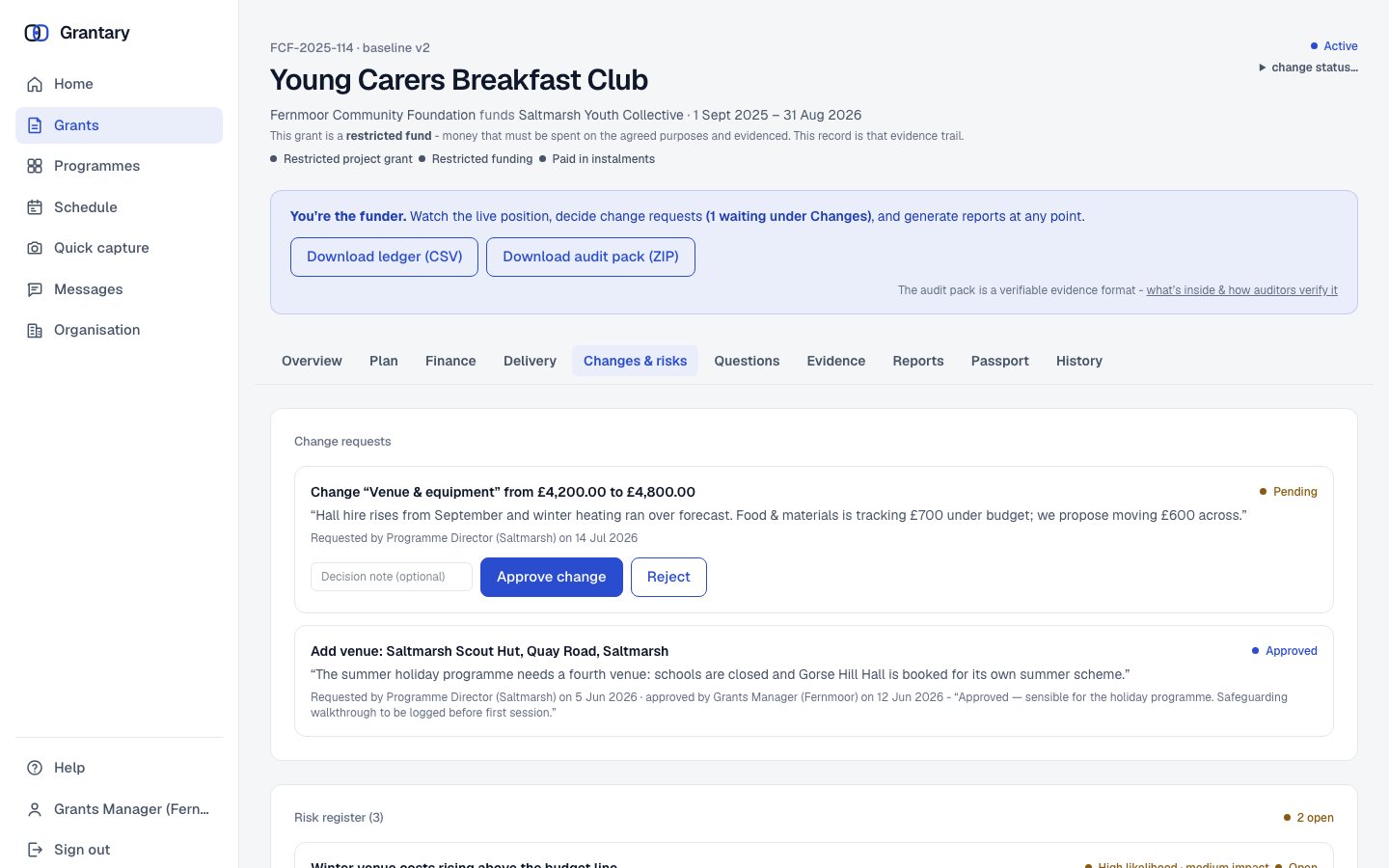
Change requests with pending and approved decisions, above a shared risk register with likelihood and impact ratings
Changes decided in the open, and a risk register both sides watch together.
  • Change is normal — so it's built ina venue falls through, a budget line needs moving, a timeline slips. The charity asks, the funder decides in writing, and the plan everyone works to is updated — with agreed tolerances for what can flex without asking at all.
  • Risks raised early, by either sidea shared early-warning list both sides can see coming. “We told you in March” becomes a link to the record, not an argument about who said what.
  • Questions answered on the recordthe replacement for the email chains that grant disputes are made of. Either side can ask, the answer lives with the grant, and only the side that asked can close the question.

Closing the loop

Reporting & the audit pack

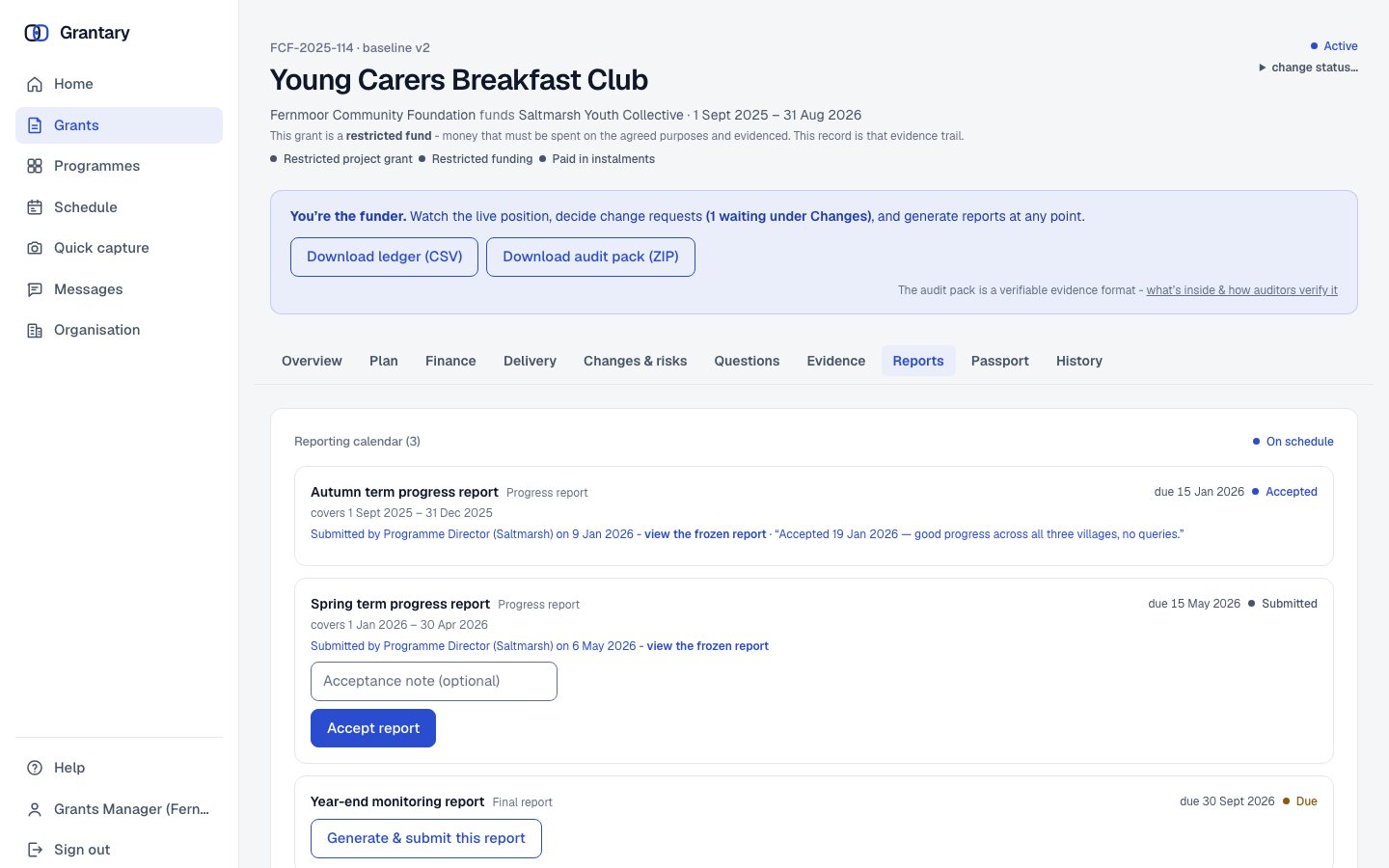
The reporting calendar showing an accepted report, a submitted report and a due report, with preserved report versions below
The reporting calendar: accepted, submitted, due — and every report kept exactly as it was submitted.
  • Reports assembled, not writtenbecause delivery, spending and evidence were recorded as they happened, a report is drawn from the live record — not rebuilt from memory. If a correction is ever needed, the new version sits alongside the original; nothing is quietly rewritten.
  • Acceptance releases the next paymentwhen the funder accepts a report, that recorded decision is what releases the instalment waiting on it. Both sides can always see what's waiting on what — no chasing, no mystery.
  • The whole grant in one downloadevidence, money, milestones, outcomes and every decision, packaged as one audit pack that an auditor can verify independently — without needing a Grantary account at all.

Why both sides can rely on it

One record, protected

The grant history: a dated diary of every event with a chain-verified badge
The story of a grant, event by event — a permanent history that either side (or an auditor) can verify.
  • A history that can't be rewrittenevery action on a grant is added to a permanent, tamper-evident history — nothing can be edited or deleted after the fact, and the whole chain can be re-checked on demand. That's what makes the shared record worth trusting.
  • Two locks on every accounta password plus a code from an authenticator app, for everyone — with sessions that can be revoked and accounts that lock after repeated failed attempts.
  • People see exactly what they shouldfine-grained roles on both sides, and what an administrator's screen says someone can do is precisely what the system enforces. Auditors get read-only access by design.